
Alabama HB25
House State Government Committee 11 Feb 2025

This report was synthesised from official meeting audio using an AI trained on GeoLawWatch’s proprietary archive of bills, calendars, and background research. While the AI assisted with the initial transcription and formatting, the final content has been reviewed for accuracy to ensure it meets our legislative reporting standards.
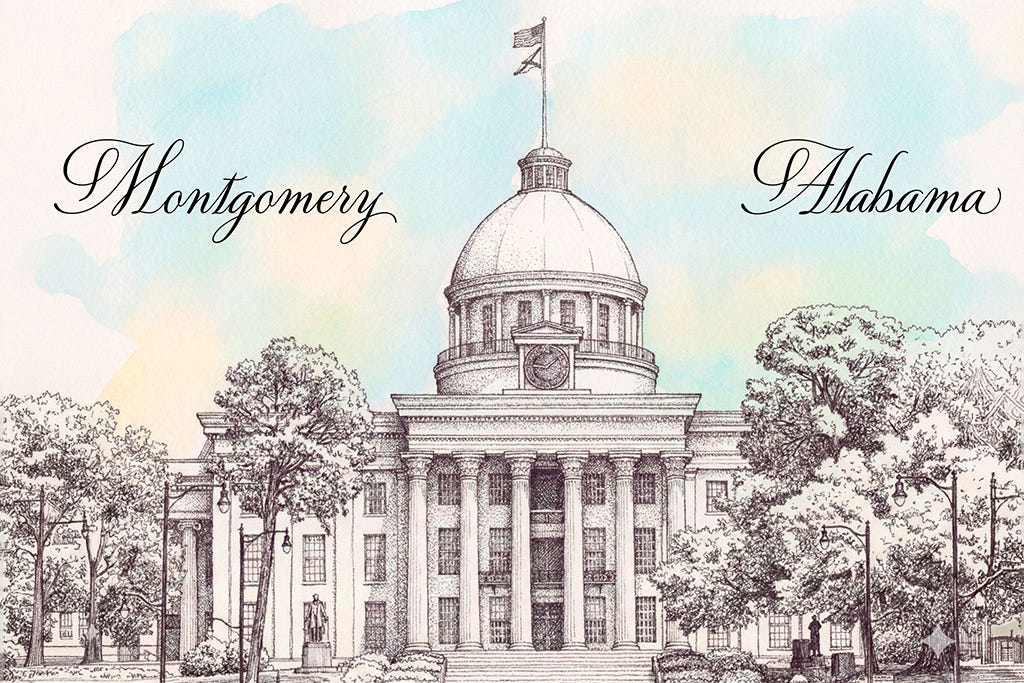
On February 11, 2026, the House State Government Committee convened to deliberate on House Bill 25 (HB25), which proposes a comprehensive regulatory framework for intentional atmospheric activities in Alabama. Representative Mack Butler, the bill’s primary sponsor, presented HB25 as both an environmental measure and an assertion of state sovereignty in response to global trends in weather modification and Solar Radiation Management (SRM). The bill aims to establish statutory boundaries to address activities that, according to proponents, lack transparency, oversight, and public consent.
Representative Butler introduced HB25 as a proactive legislative measure modelled after similar actions in Florida, Tennessee, and Louisiana. He situated the bill within the broader context of global geoengineering initiatives, referencing solar-reflectance testing and projects funded by prominent private interests, including Bill Gates. Butler also noted that “Rainmaker,” a commercial weather modification company specialising in cloud seeding, opposed the bill, using this opposition to highlight the active commercial presence in Alabama’s airspace.
HB25 establishes strict legal and financial penalties to ensure compliance. The legislation classifies the intentional atmospheric dispersion of chemicals or substances intended to affect the weather as a Class B misdemeanour, subject to a fine of up to $100,000 per violation. Fines collected would be allocated to the newly established Alabama Air Pollution Control Fund, administered by the Alabama Department of Environmental Management (ADEM). The bill also requires ADEM to create a dedicated email address and online form for public reporting of violations. After these initial remarks, the committee moved to the public testimony phase to assess the bill’s technical and historical justifications.
Expert and Witness Statements
Witnesses aimed to justify state-level intervention by characterising atmospheric phenomena as matters of public health, legal ethics, and environmental integrity. Through technical and historical testimony, proponents sought to document perceived risks associated with unmonitored atmospheric dispersion, emphasising professional observations over speculative claims.
The committee received testimony from the following expert witnesses:
Dr Ricky Roberts (Retired Vascular Surgeon and Chemical Engineer) drew on his medical and engineering expertise to argue that “geoengineering trails” differ from standard condensation trails (contrails). He referenced the Nuremberg Code, asserting that atmospheric dispersion without public awareness violates “Informed Consent.” Dr Roberts cited retired Brigadier General Charles Jones to support claims of military involvement in atmospheric spraying and raised concerns about aluminium nanoparticles bypassing the blood-brain barrier. He also suggested a causal relationship between geoengineering and the 2024 Texas flooding.
Major Bill Meili (Retired Military Officer), who holds degrees in Mechanical and Aeronautical Engineering, distinguished between short-lived contrails and persistent, intersecting “chemtrails.” He claimed that the atmospheric presence of aluminium, barium, and strontium contributes to significant health deterioration, specifically associating these substances with increased rates of Alzheimer’s, Parkinson’s, and chronic respiratory conditions.
David Williams (Retired Military Command Pilot) presented a historical overview of weather modification as a deliberate government practice, referencing the Vietnam-era Project Popeye and the high-altitude nuclear test Starfish Prime. He contended that atmospheric dispersion technology is well documented through patents and historical military operations, asserting that current dispersion activities are intentional rather than incidental.
The testimony concluded by emphasising the biological risks associated with nanoparticles, thereby preparing the committee for the subsequent interactive questioning phase.
Committee Question and Answer Session
The Question and Answer (Q&A) session served as the committee’s primary method for evaluating the scientific and legal foundations of HB25. Members concentrated on assessing the empirical validity of witness claims and the feasibility of enforcement by state agencies.
Inquiry into Empirical Science: Representative Marilyn Lands expressed considerable scepticism, conducting a live digital search for the “Geoengineering Watch” resources referenced by witnesses. She observed that these claims frequently lack endorsement from established atmospheric science institutions and requested additional scientific evidence to substantiate the bill’s premises.
Industry Opposition and Regulatory Oversight: Representative Mack Butler responded to questions regarding the bill’s necessity by noting that “Rainmaker,” a cloud-seeding company, had lobbied against the measure. He clarified that ADEM would serve as the lead agency for both the reporting infrastructure and fund management.
Demand for Documented Evidence: Representative Prince Chestnut requested specific scientific reports or verifiable data to shift the discussion from anecdotal observations of “trails” to documented evidence of systematic chemical dispersion.
Technical Clarification on Biological Impact: During a technical exchange with Dr Roberts, Representative Mack Butler discussed the “Blood-Brain Barrier.” Dr Roberts elaborated on the mechanisms by which nanoparticles may enter the bloodstream and organs directly, potentially resulting in neurological decline.
Defining Localised Harm: Representative Mike Shaw questioned the witnesses regarding specific, measurable harm occurring within Alabama. Representative Butler responded that the harm is reflected in general environmental degradation and long-term health risks, and that the bill seeks to address these proactively by prohibiting the activity.
Following these exchanges, the committee proceeded to the final procedural steps of the hearing.
Procedural Outcome and Legislative Outlook
The meeting concluded with a formal vote on the proposed legislation. Within the Alabama parliamentary process, “reporting out” a bill represents the initial critical step, signifying that the committee of origin has reviewed the measure and considers it ready for broader legislative consideration. As the House State Government Committee functions as the “House of Origin” for this measure, its approval is required for any subsequent progress.
After the Q&A session, a motion for a “favorable report” was made and seconded. The committee voted to pass HB25, thereby reporting it out of the House State Government Committee.
Having advanced beyond this procedural milestone, HB25 will next be placed on the legislative calendar for a full floor vote in the House of Representatives. If approved by the House, the measure will proceed to the Senate for further consideration during the remainder of the 2026 Regular Session.